
What is a Can Beer Case Packer?
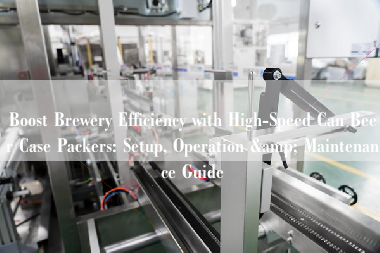
A Can Beer Case Packer is specialized automated machinery designed for the rapid, precise loading of aluminum beverage cans into shipping cases or trays. This equipment forms a critical link between the brewery’s filling line and downstream palletizing operations. Yanmao Intelligent Equipment (Suzhou) designs these systems to handle the unique challenges of beverage packaging: managing delicate cans at high speeds, accommodating various case styles (e.g., RSCs, trays, partitions), and ensuring consistent orientation. The machine automates the traditionally manual process of placing filled cans into cases, eliminating a significant production bottleneck.
Core Advantages of High-Speed Can Beer Case Packers
High-speed Can Beer Case Packers deliver transformative benefits for modern breweries. Production rates exceeding 400 cans per minute (CPM) are achievable, significantly outpacing manual operations and matching the output of high-volume filling lines. Labor reduction presents a major cost saving, automating a task prone to fatigue and injury. Precision robotic or mechanical grippers ensure gentle yet rapid placement, virtually eliminating can damage and product loss associated with manual handling. Consistent case loading improves downstream pallet stability and reduces shipping damage claims. These systems easily integrate with upstream fillers/cappers and downstream case sealers and palletizers, creating a continuous, optimized packaging line. Changeover times between different can formats or case types are minimized through smart design features.
Application Scenarios in Brewery Operations
Automated Case Packers serve vital roles across brewery packaging halls. Primary applications include placing filled cans directly from conveyor lines into standard 12-pack, 24-pack, or 30-pack cardboard cases (RSCs). They efficiently load cans into plastic or paperboard trays, often used for club store distribution. Machines configured with partition inserters handle complex packaging requiring dividers between cans. High-speed packers are essential for major production runs of flagship beers, where volume demands peak efficiency. They provide crucial flexibility for seasonal or limited-edition brews, allowing quick changeovers to different pack configurations. Microbreweries scaling up production implement these systems to maintain quality and throughput as demand grows. Integration points occur directly after can filling/seaming and before case sealing and palletizing.
Operation and Setup User Guide
Installation and Initial Configuration Steps
Proper installation establishes foundation-level performance for Yanmao Can Beer Case Packers. Site preparation requires a level concrete base with vibration-dampening properties. Minimum clearance zones around the equipment must accommodate maintenance access and material flow paths. Electrical connections follow NEMA standards with dedicated 480V circuits, while pneumatic systems demand clean, dry air at 80-100 psi. Network integration utilizes EtherNet/IP protocols for PLC communication with upstream fillers and downstream palletizers. Initial calibration involves three critical phases: conveyor alignment verification using laser levels, vacuum gripper pressure optimization tests with empty cans, and photoelectric sensor tuning for case detection. Format change kits require installation before first-run testing – including partition templates, case magazines, and can-lane guides matching specific container dimensions.
Daily High-Speed Operation Process and Efficiency Optimization
Standard operating procedures begin with power sequence activation: main disconnect engagement, HMI boot-up, and pneumatic system pressurization. Operators select pre-programmed recipes via the 15-inch touchscreen interface – parameters automatically adjust for can diameter (202/211), case style (RSC/tray), and pack configuration (12/24/30 count). Production initiation follows the sequence: case erecting station activation, can infeed conveyor start, then robotic pick-head engagement. During runs exceeding 400 CPM, real-time monitoring focuses on three efficiency metrics: can infeed stability (variance <2%), case-sealing alignment (<1mm deviation), and rejection rates (<0.3%). Optimization techniques include staggered can-lane loading to balance mechanical stress and infrared jam detection pre-triggers that prevent speed reductions. Throughput maximization occurs when downstream buffer conveyors maintain 15% capacity during peak operation.
Common Fault Diagnosis and Problem Solving
Three recurring operational anomalies require systematic troubleshooting. Can jams at transfer points typically originate from misaligned lane guides – verified using calibration rods and corrected via micrometer adjustments. Vacuum pickup failures stem from either filter clogging (resolved through scheduled diaphragm cleaning) or seal wear (replacement every 80,000 cycles). Case sealing defects manifest as either tape wrinkles (addressed by tension roller recalibration) or incomplete closures (corrected via platen pressure increases). HMI error codes follow standardized categorization: E100-series indicates mechanical faults, E200-series flags sensor malfunctions, and E300-series denotes communication errors. Critical recovery procedures include emergency stop protocols, automatic can-divert systems activation, and sequential shutdown checklists. Diagnostic tools include vibration analysis sensors and thermal imaging cameras for motor health assessment.
Maintenance and Performance Enhancement Strategies
Regular Maintenance Schedule and Best Practices
Preventive maintenance protocols maximize operational lifespan for Yanmao Can Beer Case Packers. Daily routines include vacuum gripper nozzle inspection using pressure decay tests and conveyor belt tracking verification with laser alignment tools. Weekly procedures encompass photoelectric sensor lens cleaning with isopropyl alcohol and mechanical joint lubrication per NLGI Grade 2 specifications. Monthly comprehensive checks involve torque validation of structural fasteners (35-40 Nm) and harmonic reducer oil analysis. Quarterly servicing requires full vacuum system overhaul: diaphragm replacement, filter cleaning, and leakage testing at 25 inHg. Annual maintenance entails servo motor encoder calibration and gearbox oil replacement. Critical best practices feature using OEM-compatible wear parts and maintaining maintenance logs with digital twin synchronization. Storage protocols for standby machines mandate climate-controlled environments (40-60% RH) with monthly rotation of moving components.
Upgrades and Customization Options for Automation Needs
Yanmao’s modular architecture enables performance-enhancing retrofits without full line replacement. Speed upgrades incorporate high-torque servo motors capable of 550 CPM throughput and reinforced cam followers for reduced vibration at elevated speeds. Automation expansions include robotic palletizing interfaces with standardized MQTT communication protocols and vision-guided positioning systems achieving ±0.5mm placement accuracy. Customization solutions address specialized requirements: anti-microbial coatings for wet environments, stainless steel construction for CIP washdown areas, and explosion-proof components for ethanol vapor zones. Format change acceleration kits reduce product transition time to under 5 minutes through quick-release case magazines and magnetic can guides. Connectivity upgrades feature OPC UA data gateways for real-time OEE tracking and predictive maintenance alerts integrated with SCADA systems.
Long-Term Optimization Techniques for Packing Efficiency
Sustained peak performance demands strategic operational refinements beyond routine maintenance. Motion profile optimization reduces cycle times by 8-12% through robotic path smoothing algorithms and acceleration curve adjustments. Energy efficiency initiatives utilize regenerative drive systems capturing braking energy and smart pneumatics minimizing air consumption by 30%. Data-driven improvements employ vibration analysis trending to preempt bearing failures and thermal imaging for early detection of electrical hotspots. Throughput enhancement strategies implement staggered maintenance scheduling during production gaps and kanban-based spare parts inventory systems. Operator proficiency programs include quarterly simulation training on virtual HMI platforms and cross-training for multi-system oversight. Continuous improvement methodologies leverage Six Sigma principles to achieve rejection rates below 0.15% and OEE scores exceeding 92%. Lifecycle extension protocols involve systematic component rotation and metallurgical testing of critical stress points at 50,000-hour intervals.