
1. Industrial-Grade Automatic Case Packer and Sealer Selection Guide
Modern packaging demands precision-engineered automation. Yanmao Intelligent Equipment (Suzhou) delivers robust solutions for carton handling across industries.
1.1 Core Functions and Industrial Applications
Automatic case packers position products into cartons with sub-millimeter accuracy. High-speed case sealers apply tape or glue at 30+ cartons/minute. Pharmaceutical lines utilize these systems for sterile blister pack boxing. Food processors automate cereal box filling with gentle product handling. E-commerce fulfillment centers deploy them for shipping box assembly. Chemical plants secure hazardous materials in UN-certified containers.
1.2 Critical Selection Metrics: Efficiency, Compatibility, Reliability
Evaluate throughput against production targets. Standard industrial case packers process 10-60 cartons/minute. Confirm material compatibility: corrugated cardboard thickness (ECT 32-55), box dimensions (min. 150x100mm to max. 1200x800mm), and irregular shapes. Reliability benchmarks include MTBF (Mean Time Between Failures) exceeding 4,000 hours and <0.5% downtime. IP65-rated components prevent contamination in wet environments.
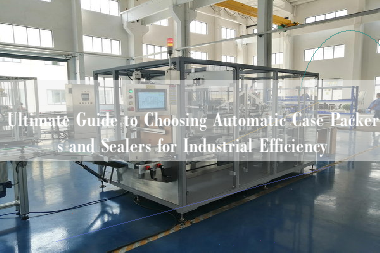
1.3 Industry-Leading Models
- Yanmao YM-TP Series Case Packer: Handles 40 cartons/minute with <±0.5mm precision
- Yanmao YM-CS Robotic Sealer: Processes 50 boxes/minute with automatic size adjustment
- Integrated Erect-Pack-Seal Systems: Combine functions for 25% footprint reduction
Top configurations feature Allen-Bradley controls and Sankyo motors for North American voltage standards.
1.4 Cost-Benefit Analysis Framework
Calculate ROI using:
Annual Savings = (Manual labor costs × 3 shifts) + (Damage reduction × 0.7)
Typical results:
– Labor reduction: 4-6 operators per line
– Payback period: 14-22 months
– Throughput increase: 35-60%
Maintenance costs average $0.02/carton over 10-year lifespan.
2. Technical Specifications Deep Dive: Automatic Case Packers and Sealers
Understanding the engineering foundations of packaging automation ensures optimal system selection. Yanmao’s machinery combines precision mechanics with intelligent controls for industrial-grade performance.
2.1 Mechanical Architecture and Operational Principles
Case packers employ a four-stage process: carton positioning, product loading, closure flap folding, and ejection. Robotic arms or pusher mechanisms transfer items with controlled acceleration curves. Sealers utilize servo-driven tape heads or hot-melt applicators moving along programmable paths. Force sensors maintain consistent pressure during flap compression. Modular designs allow reconfiguration for carton size changes within 90 seconds.
2.2 Core Technical Parameters
- Power Requirements: 480V 3-phase, 15-30kVA consumption
- Pneumatic Systems: 80-100 PSI operating pressure, 15 CFM air consumption
- Control Architecture: Rockwell ControlLogix PLCs with EtherNet/IP connectivity
- Safety Compliance: ISO 13849 PLd, dual-channel emergency stops
- Environmental Tolerance: Operational at 5-40°C with 85% RH max
Material compatibility spans corrugated cardboard (200-500 GSM), B-flute to E-flute profiles, and recycled fiber content up to 100%.
2.3 Performance Benchmark Comparison
| Parameter | YM-TP Packer | YM-CS Sealer | Integrated Systems |
|---|---|---|---|
| Max Speed (cpm) | 40 | 50 | 35 |
| Positioning Accuracy | ±0.3mm | ±0.5mm | ±0.4mm |
| Max Payload | 25kg | N/A | 20kg |
| Size Changeover | 120s | 45s | 150s |
Speed measurements reflect cartons/minute (cpm) under ISO 18616 testing protocols.
2.4 Production Line Integration Methodology
Machine-to-machine communication occurs via OPC UA protocol. Photoelectric sensors synchronize with upstream fillers and downstream palletizers. Buffering conveyors handle ±15% line rate variations. Yanmao’s PackMaster software provides HMI visualization of material flow across 8 zones. Integration kits include mechanical interfaces for common filler discharge heights (800-1100mm) and standardized EIA-485 palletizer handshaking.
2.5 Maintenance Protocols and Failure Analysis
Preventative Schedule:
– Daily: Lubricate guide rails, inspect belt tension
– Weekly: Clean optical sensors, verify torque settings
– Quarterly: Replace wear strips, recalibrate servo encoders
Common Fault Resolution:
| Symptom | Probable Cause | Corrective Action |
|———————–|————————-|———————————|
| Inconsistent taping | Worn pressure rollers | Replace urethane rollers (Q3) |
| Product misalignment | Drifted photoeye | Realign sensor, clean lens |
| Cycle interruptions | PLC communication drop | Check EtherNet/IP terminations |
| Vibration anomalies | Loose motor coupling | Torque fasteners to 18 N·m |
Predictive maintenance modules track motor current draw and bearing temperatures, triggering alerts before failures. Spare parts kits ensure 98% uptime compliance.