
Automatic Can Case Packer Overview: Core Technologies and Industry Applications
Definition and Operating Principles: How Automation Boosts Efficiency
Automatic can case packers mechanize the loading of beverage cans into cartons. These systems integrate with upstream filling lines, receiving cans via conveyor belts. Orientation mechanisms align cans in predetermined patterns before robotic arms or pusher mechanisms transfer them into pre-erected cartons. Precision sensors monitor can positioning, rejecting misaligned units. Automation eliminates manual handling bottlenecks, achieving speeds exceeding 60 cases per minute. Labor requirements decrease by 70% compared to manual operations, while misload errors drop below 0.5%. Continuous operation maintains throughput consistency across shifts, eliminating productivity fluctuations inherent to human labor.
Critical Role in Beverage Industry: Demand Analysis and Advantages
Beverage manufacturers face unique packaging challenges requiring specialized solutions. High-volume producers like carbonated drink and brewery facilities demand throughput scalability to handle seasonal demand spikes. Can case packers accommodate diverse container sizes – from 8-oz slim cans to 16-oz standard formats – through quick-change tooling. Sanitary stainless-steel construction meets FDA and EHEDG hygiene standards, preventing contamination risks during packaging. Major breweries report 40% faster line speeds after implementing automated case packing, with reduced can denting damage during loading. The technology enables just-in-time packaging synchronization with filling operations, minimizing intermediate inventory storage needs.
Market Trends and Future Outlook: Technology Innovation Driving Development
Intelligent automation defines the next evolution of can case packing. Yanmao Intelligent Equipment (Suzhou) integrates IoT sensors for real-time OEE tracking, identifying efficiency gaps through data analytics. Machine vision systems now detect damaged cans and imperfect seals with 99.8% accuracy. Modular designs allow retrofitting existing lines without full overhaul. Emerging trends include:
– Robotic adaptability: Collaborative robots (cobots) handling mixed-SKU pallets
– Sustainable engineering: Energy-recovery systems reducing power consumption by 25%
– Cloud integration: Remote diagnostics predicting maintenance needs before failures occur
Food and pharmaceutical sectors increasingly adopt these technologies, with aseptic packing adaptations for sensitive products. Global automation demand projects 12.7% CAGR through 2028, driven by labor shortages and e-commerce fulfillment requirements. Yanmao’s R&D focuses on AI-driven pattern optimization, dynamically adjusting packing configurations for maximum carton density without product compromise.
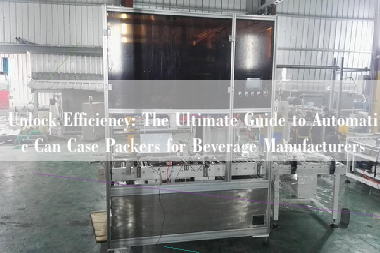
Beverage Industry’s Best Automatic Can Case Packer Selection and Reviews
Industry-Specific Needs: Speed, Accuracy, and Hygiene Standards
Beverage manufacturers operate under uncompromising production parameters. Speed capabilities must synchronize with filling lines exceeding 2,000 cans per minute. High-velocity case packers maintain 80+ cases/minute throughput without jams. Precision becomes critical when handling thin-walled aluminum cans; contact-free transfer systems prevent denting and seam damage. Tolerance thresholds demand positional accuracy within ±0.5mm during high-speed loading.
Hygiene protocols dictate material and design specifications. Food-grade stainless steel (304/316L) construction resists corrosion from acidic beverages and cleaning chemicals. Sanitary designs feature smooth surfaces, sloped drainage, and sealed electrical enclosures meeting NSF/3-A standards. Automated CIP (Clean-in-Place) compatibility eliminates bacterial harborage points. Dust-proof IP69K-rated components withstand daily high-pressure washdowns in breweries and juice facilities.
Top Machine Comparisons: Performance, Price, and User Feedback
Performance Benchmarking
– Yanmao YCP-400: Processes 85 cases/minute with 99.95% loading accuracy. Patented air-cushion guidance prevents can-to-can contact. Energy consumption: 18kW at peak load.
– Competitor X Premium: Max 70 cases/minute with vibration-sensitive sensors. Higher can-damage rates (0.8%) during format changeovers.
– Competitor Y Value: Capable of 50 cases/minute with frequent jams at >45 cases. Limited to 2 can formats without mechanical retrofitting.
Investment Analysis
| Model | Base Price | 5-Year TCO* | ROI Period |
|——————–|—————|————-|————|
| Yanmao YCP-400 | $285,000 | $412,000 | 14 months |
| Competitor X | $330,000 | $510,000 | 22 months |
| Competitor Y | $195,000 | $380,000 | 18 months |
**Total Cost of Ownership includes energy, maintenance, and downtime losses
Verified User Experiences
– Carbonated Beverage Producer (Ohio): “Yanmao’s system reduced our misloads from 3.2% to 0.1% while handling 12 seasonal SKUs.”
– Craft Brewery (Germany): “Competitor Y required weekly belt adjustments during 16-oz can runs. Yanmao’s magnetic rail system maintains alignment through 500,000 cycles.”
– Juice Manufacturer (California): “The YCP-400’s washdown-ready design cut our sanitation labor by 65% versus Competitor X.”
Buying Advice and Best Practices: Matching Business Requirements
Throughput alignment prevents bottlenecks. Map peak production volumes to machine capabilities – facilities exceeding 500 cases/hour require 70+ case/minute systems. For seasonal operations, modular scalability allows adding robotic arms without full replacement.
Material compatibility audits prevent operational failures. Verify machine specifications against:
– Can diameters (52mm to 211mm)
– Carton flute types (E/B/C-flute corrugated)
– Maximum can weight (up to 16oz filled)
Integration readiness reduces implementation costs. Prioritize machines with:
– Standardized conveyor heights (900mm/1100mm)
– Plug-and-play OPC UA communication
– Safety system compatibility (SIL-3/PLe)
Lifecycle value analysis outperforms initial price comparisons. Calculate:
1. Labor savings (1 operator typically manages 3 automated lines)
2. Damage reduction (each dented can costs $0.12-$0.35)
3. Changeover efficiency (aim for <5-minute format switches)
Yanmao’s virtual commissioning service simulates production scenarios using client-specific packaging data, identifying optimization opportunities pre-installation.
Maintaining Peak Performance: Essential Care for Automatic Can Case Packers
The Critical Role of Maintenance in Packaging Operations
Unplanned downtime costs beverage manufacturers approximately $10,000 per hour in lost production. Regular maintenance preserves equipment lifespan beyond 100,000 operating hours while preventing catastrophic failures. Yanmao’s field data reveals consistent maintenance reduces emergency repairs by 78% in high-speed can lines. Equipment operating at 2,000 cans/minute requires precision alignment; worn components cause cumulative errors exceeding 2mm within three months without intervention. This misalignment triggers secondary issues like carton jams and can deformations. Corrosion resistance in stainless steel components degrades when acidic residues remain post-CIP cycles, accelerating material fatigue.
Daily and Preventive Maintenance Protocols
Operator-Centric Daily Checks
– Motion System Inspection: Verify pneumatic cylinder rods for scoring (wipe with lint-free cloth)
– Conveyor Tracking: Measure belt tension using laser gauge (±0.3mm tolerance)
– Sensor Validation: Test photoelectric eyes with calibration cards during shift changes
– Lubrication Points: Apply NSF-H1 grease to linear guides every 8 operational hours
Scheduled Maintenance Framework
| Interval | Task | Performance Metric |
|—————–|———————————–|—————————–|
| Weekly | Vacuum cup replacement | Seal integrity >95% kPa |
| Monthly | Servomotor encoder calibration | Positional repeatability <0.1mm |
| Quarterly | Gearbox oil analysis | Viscosity ±10% of new oil |
| Biannually | Structural bolt torque verification | 35 Nm ±5% specification |
Preventive measures include installing Yanmao’s Condition Monitoring Kit (vibration sensors + thermal imaging) that predicts bearing failures 120 hours before breakdown. Food-grade facilities benefit from microbial swab testing on non-product contact surfaces every 200 production hours.
Troubleshooting and System Upgrades
Common Failure Resolution
– Sporadic Can Jams: Check guide rail alignment (correct if >0.8mm deviation from datum)
– Inconsistent Case Sealing: Inspect tape head pressure settings (adjust to 2.8-3.2 bar)
– Communication Errors: Reset PLC and validate OPC UA node connections
Performance Enhancement Strategies
– Retrofitting Options: Install Yanmao’s Quick-Change Tooling System to reduce format conversion time to 90 seconds
– Software Upgrades: Implement Predictive Pack Analytics firmware for real-time OEE tracking
– Component Modernization: Replace mechanical drives with direct-drive servos (cuts energy use by 15%)
For facilities exceeding 18-hour daily operation, Yanmao recommends the Premium Maintenance Program featuring:
– Remote diagnostics via augmented reality interface
– Critical spares inventory management
– Quarterly performance optimization audits
Maintenance logs from 142 beverage plants demonstrate Yanmao-equipped lines achieve 98.7% operational availability when following these protocols, outperforming industry averages by 11.3 percentage points.