
1. Vertical Beer Case Packer Overview
Yanmao Intelligent Equipment (Suzhou) designs vertical beer case packers to automate bottle loading into cartons. These systems handle glass or PET bottles across diverse beverage production lines.
1.1 Definition and Operating Principle
A vertical beer case packer positions bottles upright directly into open cartons. Empty bottles enter via an infeeding conveyor. Precision grippers or pusher mechanisms arrange bottles into predefined patterns. The grouped bottles transfer vertically into awaiting cartons. Integrated sensors verify correct positioning before releasing the loaded carton. Yanmao models incorporate servo-driven motion control for pattern flexibility.
1.2 Applications and Operational Benefits
This equipment serves breweries, cider producers, and carbonated drink facilities. Primary use cases include:
– High-speed bottling lines exceeding 550 bottles/minute
– Mixed-SKU packaging with rapid changeovers
– Handling varying bottle heights/diameters within one carton
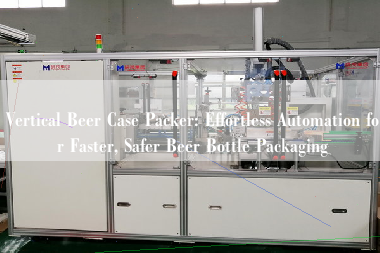
Key advantages address critical production challenges:
Labor Reduction
Automation replaces 3-5 manual packers per shift. Operators shift to supervisory roles.
Throughput Enhancement
Continuous operation achieves 98% uptime versus manual packing fatigue.
Damage Prevention
Guided vertical loading eliminates bottle tipping and neck damage.
Space Optimization
Vertical orientation requires 40% less floor space than rotary packers.
Breweries using Yanmao vertical packers report 18-month ROI through labor savings and reduced breakage. Seasonal production surges become manageable without temporary hires.
2. Vertical Beer Case Packer Operating Guide
2.1 Equipment Setup and Initialization
Execute these preparatory steps before production runs:
1. Carton Magazine Loading
– Stack pre-glued cartons vertically in the magazine
– Adjust side guides to match carton dimensions
– Confirm vacuum suction cups align with carton flaps
2. Infeed Conveyor Calibration
– Set bottle guide rails 5mm wider than bottle diameter
– Program bottle grouping pattern via HMI touchscreen
3. Gripper System Configuration
– Select comb-type pusher or vacuum gripper attachment
– Test grip pressure using calibration bottles
4. Safety System Verification
– Activate light curtains and emergency stops
– Confirm obstruction sensors detect test objects
Initialize by powering the main control panel, then run the self-diagnostic sequence. Load 10 test cartons for dry-run validation at 50% speed.
2.2 Daily Operation Procedures
Follow this workflow for standard production:
Startup Sequence
– Engage main power switch
– Select preset recipe on HMI
– Initiate automatic carton erection cycle
– Start infeed conveyor gradually
Running Operations
– Monitor real-time throughput on dashboard
– Verify bottle alignment at transfer points
– Clear jammed bottles using manual override
– Record downtime incidents in logbook
Shutdown Protocol
– Empty all bottles from conveyor
– Complete partial carton manually
– Run automatic lubrication cycle
– Power off using sequenced shutdown
During operation, check carton glue application every 30 minutes. Maintain 60-80% humidity to prevent carton warping.
2.3 Safety Precautions
Critical safety measures include:
Personal Protection
– Wear cut-resistant gloves during jam clearance
– Use safety glasses near moving mechanisms
– Secure loose clothing and hair
Machine Safeguards
– Never bypass light curtain sensors
– Verify lockout/tagout during maintenance
– Keep emergency stop buttons unobstructed
Hazard Zones
– Maintain 1-meter clearance around gripper area
– Avoid reaching beneath descending pusher plate
– Isolate power before clearing bottle jams
Operators must complete Yanmao’s VR safety training module. Report abnormal vibrations immediately. Post safety schematics near all access panels.
3. Vertical Beer Case Packer Maintenance and Care
3.1 Scheduled Maintenance Procedures
Implement these preventive maintenance protocols:
Daily Tasks
– Wipe vacuum grippers with alcohol wipes
– Clear debris from bottle guide rails
– Inspect carton magazine alignment
– Verify emergency stop functionality
Weekly Procedures
– Lubricate chain drives with food-grade grease
– Calibrate light curtain sensors
– Check pneumatic valve responsiveness
– Measure belt tension on transfer conveyors
Quarterly Actions
– Replace worn suction cup seals
– Test motor amperage draw
– Update PLC firmware
– Inspect structural welds for stress cracks
Maintain detailed service logs tracking component replacements. Schedule infrared thermography scans annually to detect electrical anomalies.
3.2 Common Fault Diagnosis and Resolution
Address frequent operational disruptions:
| Symptom | Diagnostic Steps | Corrective Action |
|---|---|---|
| Carton misfeeds | 1. Check magazine vacuum pressure 2. Inspect flap sensors 3. Verify carton glue quality | Adjust suction cup position Clean photoeyes Replace adhesive rolls |
| Bottle misalignment | 1. Measure guide rail clearance 2. Test encoder accuracy 3. Observe grouping timing | Recalibrate infeed conveyor Reset bottle counter Adjust pusher stroke |
| System halts unexpectedly | 1. Review error code history 2. Check safety circuit continuity 3. Monitor voltage fluctuations | Reset thermal overload relays Replace faulty E-stop button Install voltage stabilizer |
For PLC communication failures, cycle power after 120-second delay. Persistent servo motor faults require torque curve analysis.
3.3 Longevity Optimization Techniques
Maximize operational lifespan through:
Operational Practices
– Maintain ambient temperature below 35°C (95°F)
– Limit production speed to 85% of rated capacity
– Implement 5-minute cooldown cycles every 4 hours
Component Preservation
– Install dust covers during non-production hours
– Rotate multiple gripper attachments weekly
– Use vibration dampeners on mounting points
Preventive Upgrades
– Retrofit stainless steel components in wet environments
– Upgrade to brushless DC motors after 15,000 hours
– Apply nanocoatings to sliding surfaces
Conduct biannual wear particle analysis on lubricants. Store spare circuit boards in anti-static containers with humidity control. Replace all pneumatic hoses at 5-year intervals regardless of visible wear.
4. Vertical Beer Case Packer Pricing and Procurement
4.1 Cost Determinants
Multiple variables influence vertical case packer pricing:
Performance Specifications
– Bottles/minute rating (Standard range: 60-150 bottles)
– Format changeover complexity (Quick-change vs. tool-based)
– Carton size adaptability (Min/Max dimensions)
– Integration level (Standalone vs. PLC-linked systems)
Component Quality
– Stainless steel percentage (304 vs. 316 grade)
– Vacuum system type (Centralized vs. decentralized)
– Motor specifications (Servo vs. AC inverter)
– Sensor brands (Sick, Omron, or generic alternatives)
Operational Expenses
– Energy consumption per 1,000 cases
– Compressed air requirements (CFM at 80-100 psi)
– Annual maintenance costs (Typically 5-8% of purchase price)
– Spare part availability lead times
Budget 15-20% extra for installation/commissioning. Consider 3-year ROI calculations factoring labor savings per shift.
4.2 Market Brand Evaluation
Key manufacturers differ in value propositions:
| Segment | Key Players | Typical Price Range | Distinguishing Features |
|---|---|---|---|
| Premium Tier | Krones, KHS | $250,000-$500,000 | FDA-compliant materials Under 2s format change Remote diagnostics |
| Value Leaders | Yanmao, Sidel | $120,000-$220,000 | 100-130 bottles/minute IP65 protection HMI troubleshooting guides |
| Niche Specialists | PakTech, E-PAK | $80,000-$150,000 | Compact footprints Mechanical simplicity Manual adjustment points |
European brands command 30-50% premiums for pharmaceutical-grade certifications. Asian manufacturers offer broader material compatibility (plastic crates/wet cartons).
4.3 Procurement Strategy
Follow this selection protocol:
Requirement Mapping
– Audit current line speed bottlenecks
– Document carton/bottle dimension tolerances
– Verify facility power/air infrastructure
– Determine sanitation protocols (Washdown vs. dry clean)
Supplier Assessment
– Request factory acceptance test (FAT) documentation
– Validate regional service network coverage
– Review spare parts pricing lists
– Confirm cybersecurity compliance (IEC 62443)
Decision Framework
– Prioritize <25 minute format changes for craft breweries
– Choose servo-driven actuators for <±0.5mm positioning
– Opt for modular designs when anticipating future upgrades
– Select vendors offering operator training packages
Conduct material tests using actual production cartons. Negotiate performance guarantees covering throughput consistency. Always budget for 2-3 critical spares (vacuum generators, PLC modules).
Final Checklist
☐ Validated energy consumption data
☐ 24/7 technical support response times
☐ CE/UL certification documentation
☐ Observed 8-hour continuous production run