
Automatic Case Packer for Canned Goods in the Food Industry: Applications and Advantages
Yanmao Intelligent Equipment (Suzhou) specializes in advanced packaging automation solutions, addressing critical challenges in modern manufacturing. Automatic case packers for canned goods represent a key innovation, streamlining processes from filling to boxing. These systems handle cans efficiently, reducing manual labor and boosting throughput. This section explores the definition, applications, and essential features of these machines, highlighting their role in enhancing productivity within the food industry.
Definition, Working Principle, and Core Components
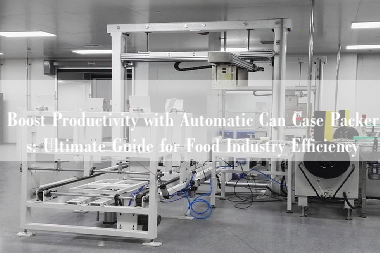
An automatic case packer for canned goods is a specialized machine designed to load cans into cartons with precision and speed. It automates the boxing process, eliminating manual handling to ensure consistency and minimize errors. The working principle involves a sequence of steps: cans enter via a conveyor system, are oriented correctly, and then inserted into pre-formed cases. Core components include an infeed conveyor for transporting cans, a case erector for setting up cartons, a robotic or mechanical packing unit for placing cans into cases, and a control system for monitoring and adjustments. Yanmao integrates high-quality sensors and programmable logic controllers (PLCs) to optimize performance, ensuring reliable operation in high-volume environments. These components work seamlessly to handle various can sizes, from small tins to large industrial containers.
Specific Application Scenarios in the Food Industry and Efficiency Improvements
Automatic case packers are vital in food processing facilities, particularly for canned fruits, vegetables, soups, and beverages. Common scenarios include packaging lines in canneries, where machines load filled cans into cartons after sealing and labeling. For instance, in a tomato processing plant, Yanmao’s case packers handle up to 60 cans per minute, reducing the need for multiple workers and cutting labor costs by over 50%. Efficiency improvements are significant: throughput increases by 30-40% compared to manual methods, with consistent output reducing product damage and waste. This automation supports just-in-time production, allowing manufacturers to scale operations during peak seasons without adding staff. Real-world deployments in North American and European food plants demonstrate measurable gains, such as higher line speeds and lower operational expenses.
Key Features and Industry Requirement Analysis
Key features of automatic case packers include high automation levels, with options for robotic integration to handle complex patterns. Hygiene standards are paramount; Yanmao designs machines with stainless steel surfaces, easy-clean components, and sealed mechanisms to prevent contamination, complying with food safety regulations like HACCP and FDA guidelines. Industry requirements demand certifications such as ISO 22000 for food safety, ensuring machines meet global standards for traceability and sanitation. Automation capabilities minimize human intervention, enhancing safety and reducing error rates. Yanmao’s systems incorporate adjustable settings for different can and carton sizes, supporting flexibility across diverse product lines. Analysis shows these features directly address food industry needs, delivering ROI through reduced downtime and compliance with stringent quality controls.
Best Can Case Packer Price Comparison and Purchasing Guide
Navigating the market for can case packers requires strategic evaluation of equipment costs against operational benefits. This guide examines pricing structures across leading brands and provides actionable strategies for optimizing investments in automated can packaging systems. Manufacturers seeking efficient solutions for canned goods packaging must balance upfront expenses with long-term productivity gains.
Market Mainstream Brands and Model Overview
Leading manufacturers offer diverse can case packer models addressing varying production scales. Yanmao Intelligent Equipment provides robust mid-range systems like the CP-200 series, featuring adjustable grippers for multiple can diameters. Industry giants such as Bosch and Krones deliver premium-tier machines with advanced vision systems, while regional suppliers offer entry-level models. Market analysis reveals three primary categories: basic mechanical packers (40-60 cans/minute), robotic-arm systems (80-120 cans/minute), and integrated erector-packer-sealer units. Yanmao’s modular designs stand out for scalability, allowing seamless upgrades from semi-automatic to fully robotic configurations. Current market trends show growing demand for compact footprint machines with <5-minute changeover capabilities for food production environments.
Price Factors and Comparison Methods
Can case packer pricing varies significantly based on critical specifications:
– Throughput capacity: Systems exceeding 100 cans/minute command 25-40% premiums over standard 60-unit models
– Automation level: Robotic integration increases costs by 35-50% versus mechanical systems
– Material compliance: FDA-grade stainless steel construction adds 15-25% to base prices
– Certification requirements: Machines with EHEDG or 3-A certifications carry 10-20% cost increments
Effective comparison requires evaluating total cost of ownership beyond initial purchase. The performance-price matrix demonstrates that mid-tier systems often deliver optimal value, balancing 3-5 year ROI periods with 30-50% labor reduction. Yanmao equipment exemplifies this balance, with standardized components reducing maintenance expenses by 20-35% compared to custom-engineered alternatives. Production simulations prove essential for accurate comparisons, mapping machine speeds against actual line requirements to avoid overinvestment.
Purchasing Strategies and Cost-Effectiveness Optimization
Strategic acquisition of can case packers involves three critical assessments:
1. Lifecycle cost analysis: Calculate 5-year expenses including energy consumption ($0.15-0.25/case), preventive maintenance (2-4% of capital cost annually), and spare parts inventory
2. ROI validation: Use the formula: (Annual labor savings + Waste reduction) / (Equipment cost + Installation) < 36 months
3. Future-proofing: Select systems accommodating 20-30% capacity expansion without structural modifications
Food industry deployments reveal critical cost-effectiveness drivers: Opt for machines with CIP (clean-in-place) compatibility to reduce sanitation labor by 60%. Prioritize suppliers offering remote diagnostics and regional spare parts depots, minimizing downtime costs. Yanmao’s North American service network demonstrates this advantage, providing <24hr response times for critical failures. Industry benchmarks indicate optimal configurations for canned goods: robotic case packers with dual-gripper technology for mixed-SKU lines, and integrated systems with automatic case erectors for high-volume single-product facilities. Production managers report 18-28 month payback periods when implementing Yanmao’s energy-efficient CP-Series with variable-speed drives.