
1. Food Carton Case Packer Price Comparison Analysis
Selecting the right food carton case packer involves understanding cost variations. Price points differ significantly based on machine type, capabilities, and manufacturer. Yanmao Intelligent Equipment (Suzhou) offers solutions fitting diverse budgets while maintaining performance standards.
1.1 Brand and Model Price Comparison (Fully Automatic vs. Semi-Automatic)
Food carton case packer pricing reflects automation levels and complexity. Fully automatic case packers command higher initial investment. These systems handle carton erection, product loading, and sealing without manual intervention. Prices typically range from $80,000 to $250,000+ depending on speed, precision, and integration capabilities.
Semi-automatic case packers present a lower entry point, often between $25,000 and $70,000. Operators manually place cartons or assist with product loading. While reducing upfront costs, these models generally offer lower throughput and require consistent labor.
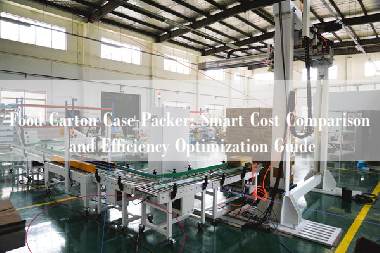
Brand reputation influences pricing. Established manufacturers like Yanmao incorporate proven engineering and durable components, impacting cost versus lesser-known alternatives. Comparing specifications like cycles-per-minute (CPM) and material compatibility provides clearer value assessment than price alone.
1.2 Key Factors Influencing Case Packer Pricing
Several core elements determine food carton case packer costs:
- Throughput Capacity: Machines rated for 15+ cases per minute (CPM) carry premium pricing over slower units (5-10 CPM). High-speed systems demand robust mechanics and advanced controls.
- Technology & Configuration: Pricing rises with advanced features: robotic arm integration, vision-guided product placement, automatic size changeover, touchscreen HMIs, and compatibility with upstream/downstream automation (like case erectors or palletizers).
- Material Handling & Versatility: Systems handling diverse carton sizes/styles (RSCs, trays, die-cut) or fragile products often require specialized tooling or grippers, increasing cost.
- Build Quality & Components: Industrial-grade steel frames, precision servo motors, and branded PLCs (e.g., Siemens, Rockwell) contribute to higher prices but ensure longevity and reliability.
- Customization: Standard models cost less. Solutions tailored for unique carton designs, sterile environments (food/pharma), or specific product characteristics involve engineering resources, elevating the price.
1.3 Value-Based Selection and ROI Analysis
Choosing a food carton case packer requires evaluating total cost of ownership (TCO) and projected return on investment (ROI):
- Labor Cost Reduction: Fully automatic case packers significantly cut labor needs. Calculate savings by comparing manual packing wages to the automated solution’s operational cost. A $150,000 machine replacing 3 shifts of manual labor often achieves payback in 1-3 years.
- Throughput Gains & Error Reduction: Automation boosts output consistency. Higher CPM machines increase production capacity without expanding labor. Reduced product damage and mispacks lower waste costs.
- Operational Efficiency: Integrated systems minimize line stoppages. Compatibility with case erectors and case sealers streamlines flow. Reduced changeover times enhance flexibility.
- Longevity & Support: Investing in robust equipment like Yanmao’s case packers minimizes downtime and maintenance costs over a longer lifespan compared to cheaper alternatives. Factor in warranty terms and service availability.
Prioritize features delivering measurable operational benefits. A semi-automatic packer may suffice for low-volume, high-mix lines. High-volume food producers gain maximum ROI from fully automatic, high-speed Yanmao case packers through labor savings, increased output, and enhanced quality control.
2. Efficient Operation Strategies for Food Carton Case Packers
Optimizing food carton case packer performance requires strategic operational approaches. Yanmao Intelligent Equipment delivers advanced systems enabling manufacturers to maximize throughput while minimizing disruptions through intelligent design and process refinement.
2.1 Operational Process Optimization Techniques
Traditional case packing methods often involve sequential manual operations: carton positioning, product alignment, and manual quality checks. These approaches create bottlenecks limiting production speeds to 5-10 cases per minute. Human-dependent processes exhibit variability in placement accuracy and carton orientation consistency.
Innovative automation strategies transform packing workflows. Yanmao’s integrated systems employ synchronized robotic arms with vision-guided positioning achieving 20-30 CPM. Self-adjusting grippers accommodate irregular product shapes without manual intervention. Real-time sensor feedback automatically corrects misaligned cartons during continuous operation. Machine learning algorithms analyze historical jam patterns to preemptively adjust conveyor speeds. These methodologies reduce human-touch points by 80% while maintaining precise product orientation for fragile items.
2.2 Common Problem Resolution Comparisons
Carton jams represent frequent disruptions in packing operations. Conventional troubleshooting involves complete line stoppage, manual jam clearance, and trial-and-error restart attempts. This approach typically causes 15-30 minutes of unplanned downtime per incident, accumulating significant production losses. Reactive solutions often fail to address root causes like carton warping or humidity-related material changes.
Proactive resolution systems integrate predictive diagnostics. Yanmao case packers feature intelligent jam detection sensors that trigger automatic reversal sequences, clearing obstructions in under 60 seconds without operator intervention. Vibration analysis monitors motor performance to identify bearing wear before failures occur. Humidity-controlled staging areas maintain carton integrity. These solutions reduce jam-related downtime by 92% compared to manual methods while preventing secondary damage to products.
2.3 Maintenance and Training Best Practices
Short-term efficiency approaches focus on immediate fixes: reactive component replacements, emergency technician call-outs, and abbreviated operator training. These methods yield temporary performance recovery but incur higher long-term costs. Unplanned maintenance events cause 3-5% production losses annually in typical operations. Basic operational training leaves gaps in troubleshooting knowledge, increasing error rates during product changeovers.
Comprehensive maintenance protocols establish sustainable efficiency. Yanmao implements IoT-enabled predictive maintenance with real-time equipment health monitoring. Automated lubrication systems extend bearing life by 40%. Modular component design enables swap-out repairs in under 15 minutes. Structured training programs combine virtual reality simulations with hands-on sessions covering advanced diagnostics, sanitation protocols for food safety compliance, and size-changeover optimization. Certified technicians achieve 30% faster troubleshooting resolution. These integrated practices maintain peak efficiency throughout equipment lifecycles while reducing annual maintenance costs by 25%.