
1.1 Definition and Core Function: What is a Top-Loading Case Packer?
A Top-Loading Case Packer automates the insertion of products into an upright, open-top shipping case or carton. Its primary function is to accurately place products – whether individual items, grouped bundles, or pre-formed trays – vertically downward into the waiting container. This method contrasts sharply with horizontal (end-loading) insertion. Top-loading systems are characterized by their overhead product handling path and downward placement motion, making them essential for specific product types and high-volume packaging lines seeking gentle, efficient handling.
1.2 Typical Application Scenarios: Industries and Products
Top-loading case packers excel in industries and applications where product characteristics demand careful vertical placement or where horizontal insertion is impractical:
Food & Beverage: Bagged snacks, cereal boxes, frozen food boxes, bottled water multipacks, pouches, bakery trays, canned goods (in trays), wrapped confectionery.
Pharmaceuticals & Healthcare: Blister packs, medicine bottles, vials, pre-filled syringes in trays, medical device kits, wrapped diagnostic products.
Consumer Goods: Shampoo bottles, detergent pouches, cosmetic boxes, aerosol cans (in trays), bundled hardware items, soft goods (towels, apparel).
General Manufacturing: Electronics in trays, small appliances, poly-bagged components, lightweight assemblies.
Products benefiting most are often lightweight, gravity-sensitive, irregularly shaped, soft, or already grouped into unstable configurations requiring vertical support during packing.
1.3 Core Advantage Overview: Why Choose Top-Loading?
Selecting a top-loading system offers distinct operational advantages:
Gentle Product Handling: Vertical insertion minimizes friction and impact, protecting fragile, delicate, or easily scuffed items.
Ideal for Loose/Pliable Products: Gravity-assisted placement effectively handles soft bags, pouches, and loosely bundled items that might jam or deform in horizontal systems.
High-Speed Potential: Well-designed top-loaders achieve significant packing rates, particularly for products easily dropped or placed.
Space Optimization: The vertical drop path often allows for a smaller machine footprint compared to some complex horizontal systems requiring long transfer conveyors.
Simplified Integration: Naturally interfaces with upstream equipment like tray formers, baggers, and bundlers feeding product downward.
Reduced Product Damage: Minimizes crushing or abrasion risks associated with pushing products horizontally into cases.
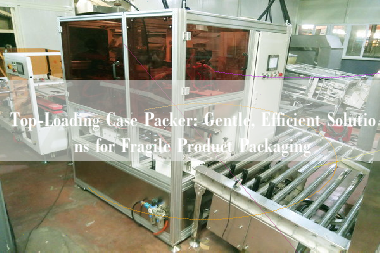
1.4 Basic Component Structure: Key Machine Parts
A top-loading case packer integrates several critical subsystems working in sequence:
1. Case Erector / Magazine: Holds flat case blanks. A Case Erector precisely extracts, unfolds, squares, and secures (often with bottom flaps partially sealed) the case into its upright position on the packing line.
2. Case Conveyor / Indexing System: Moves the erected case precisely to the loading station and holds it securely during product insertion.
3. Product Infeed Conveyor: Transports products from upstream equipment (like fillers, baggers, bundlers, or robotic cells) to the loading point above the open case.
4. Product Grouping / Timing Section (Optional): Organizes individual products into the precise pattern required for the case pack configuration before loading.
5. Product Loading Mechanism: The core of the top-loader. This can be:
*   **Gravity Drop:** Products fall directly into the case through chutes or guides. Simple, fast, for stable products.
*   **Plunger/Pusher Mechanism:** A vertical pusher gently guides products or product groups down into the case. Offers more control than pure gravity.
*   **Robotic Arm:** A robotic arm picks products/groups and places them vertically into the case. Highest flexibility for complex patterns or delicate items.
- Case Flap Folding & Sealing System: After loading, mechanisms fold the top flaps inward and apply adhesive tape or hot melt glue to securely seal the case. May include flap tampers for positive closure.
- Control System (PLC/HMI): The programmable logic controller and human-machine interface manage machine sequencing, synchronization, speed control, fault detection, and operator interaction.
2.2 Drive and Control: Power Systems and Automation Logic
The operational precision of top-loading case packers stems from sophisticated power transmission systems and deterministic control logic. Yanmao Intelligent Equipment (Suzhou) integrates robust electromechanical architectures with industrial automation protocols to achieve synchronous motion control across all machine subsystems.
Power Transmission Fundamentals
– Servo-Driven Actuation: High-torque servo motors govern critical axes like case indexing, plunger descent, and flap manipulation, enabling variable-speed profiles for delicate product handling.
– Pneumatic Supplementation: Compressed air cylinders execute rapid auxiliary motions – vacuum cup engagement for blank retrieval, pneumatic rams for flap folding, and gripper actuation in robotic placements.
– Kinematic Chain Optimization: Helical gear reducers and timing belt drives minimize backlash during direction reversals, maintaining positional accuracy within ±0.5mm during high-cycle operations.
Control System Architecture
– PLC-Centric Logic: Redundant PLCs (Rockwell/Allen-Bradley or Siemens platforms) execute deterministic sequencing, monitoring inputs from 200+ I/O points per machine module.
– Motion Coordination: Electronic camming synchronizes the product infeed conveyor velocity with case positioning signals, eliminating product-to-container misalignment.
– HMI Visualization: 15-inch capacitive touchscreens display real-time OEE metrics, including cycle times, jam locations, and energy consumption per packed case.
Safety Integration
– Category 3 Safety Circuits: Dual-channel safety relays interface with light curtains guarding drop zones and emergency stop loops meeting ISO 13849 requirements.
– Predictive Monitoring: Vibration sensors on rotary actuators and thermal imaging on servo drives trigger maintenance alerts before component degradation affects packaging integrity.
– Fault-Tolerant Design: Position validation sensors (inductive proximity, photoelectric) at each station create a permissive chain – any missed signal halts downstream actions until resolution.
Automation Logic Flow
1. Case Erector Initiation: Blank presence sensors trigger servo-assisted suction cup engagement upon magazine depletion signal.
2. Position Locking: Rotary encoders confirm case squareness before mechanical clamps secure container walls during loading.
3. Drop Phase Control: For gravity systems, laser distance sensors verify product clearance; plunger mechanisms utilize load cells to maintain constant insertion force.
4. Sealing Verification: Post-seal inspection cameras validate adhesive bead continuity before case release to downstream palletizing.
This integrated drive-control ecosystem enables throughput scalability from 15-60 cases/minute while maintaining <0.1% misload rates across carton size transitions. Yanmao’s IEC 61131-3 compliant codebase allows seamless integration with plant-wide SCADA/MES layers for batch tracking and recipe management.
3. Comparison Analysis and Selection Considerations: Top Loading vs. Other Loading Methods
Selecting the optimal carton loading methodology requires evaluating fundamental operational differences. Top-loading and end-loading cartoning machines serve distinct purposes dictated by product characteristics, line constraints, and production goals.
3.1 Top Loading vs. End Loading Cartoning Machines: Critical Distinctions
Product Compatibility and Orientation
– Top Loading: Excels with gravity-friendly products: pouches, blister packs, soft goods, and loose components. Vertical product insertion minimizes compression forces on delicate items. Fragile cosmetics, snack bags, and medical device kits benefit from controlled free-fall or guided placement.
– End Loading: Requires structurally stable products capable of horizontal movement. Ideal for rigid containers like bottles, cans, and vials inserted laterally. Product integrity depends on consistent orientation during pushing mechanisms.
Machine Architecture and Footprint
– Top Loading: Vertical design integrates above conveyors, conserving floor space. Modular configurations stack case erecting above loading zones. Typical height ranges from 2.5-4 meters, requiring adequate overhead clearance.
– End Loading: Horizontal layout demands greater floor area for inline product transfer and pushing mechanisms. Linear designs extend 3-6 meters along production lines.
Throughput and Efficiency
– Top Loading: Achieves 25-60 cycles/minute for lightweight, non-oriented products. Speed advantages emerge when handling items requiring minimal positioning. Gravity-assisted insertion reduces mechanical complexity.
– End Loading: Sustains 15-40 cycles/minute for oriented rigid goods. Speed constraints occur during precise alignment of containers prior to lateral insertion.
Product Damage Risk Profile
– Top Loading: Minimal contact during insertion reduces surface abrasion. Critical for coated pharmaceuticals or printed packaging. Drop height control via servo plungers prevents impact damage.
– End Loading: Lateral pushing mechanisms create friction points. Requires precision tooling to avoid glass scoring or label scuffing.
Changeover Complexity
– Top Loading: Quick-release tooling adapts to carton sizes within 15 minutes. Adjustments focus on guide rails and plunger stroke settings. Format flexibility favors mixed-SKU environments.
– End Loading: Demands pusher arm reconfiguration and conveyor width adjustments. Changeover typically requires 30-45 minutes for significant size transitions.
Investment Considerations
– Top Loading: Entry-level systems start near $85,000; high-speed robotic variants exceed $220,000. Lower lifetime maintenance costs for gravity-based systems.
– End Loading: Standard configurations range $75,000-$180,000. Higher wear components (pushers, rails) increase long-term upkeep.
3.2 Alternative Loading Methodologies
Horizontal side-load systems provide niche solutions for long, narrow products like syringes or hardware. Rotary wheel loaders achieve ultra-high speeds (100+ cycles/minute) for uniform items like vials but lack format flexibility.
3.3 Selection Framework: Key Decision Drivers
Use this criteria matrix to determine optimal technology:
| Factor | Top Loading Advantage | End Loading Advantage |
|---|---|---|
| Product Fragility | High (gravity-sensitive items) | Low (rigid containers) |
| Footprint Priority | Vertical space available | Horizontal space available |
| Target Speed | >40 cycles/minute | <40 cycles/minute |
| Changeover Frequency | Multiple daily format changes | Infrequent size adjustments |
| Primary Budget Focus | Long-term operational efficiency | Lower initial acquisition cost |
Implementation Protocol:
1. Conduct product drop testing to validate gravitational stability
2. Measure available installation height versus floor space
3. Audit required OEE versus acceptable jam rates
4. Validate changeover time allowances against production schedules
5. Compare total cost of ownership over 5-year horizon
Yanmao Intelligent Equipment engineers recommend top-loading configurations for facilities packing diverse fragile goods at medium-to-high volumes. End-loading systems remain preferable for dedicated high-volume rigid container lines with infrequent changeovers.
4. Application, Maintenance and Future Trends
Top-loading cartoning systems deliver precision packaging across diverse manufacturing sectors. Their vertical product handling capabilities address unique production challenges while evolving to meet next-generation automation demands.
4.1 Success Stories: Industry-Specific Implementations
Food Production: Leading snack manufacturers deploy top-loaders for fragile items like potato chip bags and granola pouches. Gravity-assisted insertion prevents crushing during 50-cycle/minute operations. One breakfast cereal producer achieved 32% labor reduction after installing Yanmao systems across six lines.
Pharmaceuticals: Sterile facilities utilize servo-controlled top-loaders for blister packs and medical kits. Positive-pressure HEPA zones integrate with vertical loading paths. A vaccine packaging site eliminated 99.8% particulate contamination through enclosed insertion chambers.
Cosmetics: Luxury skincare brands rely on top-loading for delicate compacts and glass dropper bottles. Custom foam inserts cradle products during 18cm controlled drops. A European manufacturer reduced breakage rates from 1.2% to 0.05% after implementation.
FMCG: Household goods producers pack irregular items like sponges and brush heads. Adjustable guide rails accommodate non-uniform geometries. One detergent pod manufacturer increased throughput by 22 packages/minute while handling three SKU formats.
Hardware: Industrial suppliers automate small-part packaging for screws, washers, and electronic components. Magnetic vibratory feeders orient metal items before top-loading. A tool manufacturer eliminated manual sorting for 78 product variants.
4.2 Operational Protocols and Safety
Standard Operating Procedures:
– Pre-run verification: Carton stock alignment, product feed synchronization, and sealing temperature calibration
– Motion sequence validation: Confirming pusher stroke lengths and drop heights match product specifications
– Emergency protocols: Immediate shutdown procedures for material jams or sensor failures
Critical Safety Systems:
– Light curtains halt operations when access doors open
– Torque-limited drives prevent crushing injuries during maintenance
– Ground-fault circuit interrupters on all electrical components
– Lockout-tagout (LOTO) compliance per OSHA/CE standards
Operators require certified training on pneumatic system isolation and mechanical guarding bypass prevention. Yanmao systems include RFID-tagged safety manuals accessible via machine-mounted tablets.
4.3 Maintenance Framework
Preventative Schedule:
| Frequency | Key Tasks | Metrics |
|—————|—————————————-|——————————|
| Daily | Vacuum cup inspection, debris removal | Suction pressure >0.6 bar |
| Weekly | Guide rail lubrication, belt tensioning| Deflection <3mm per 100cm |
| Monthly | Servo motor calibration, seal bar wear | Position accuracy ±0.2mm |
| Quarterly | Structural bolt torque verification | 90-110% specified Nm |
Troubleshooting Matrix:
| Symptom | Probable Cause | Corrective Action |
|—————————|————————————-|————————————-|
| Inconsistent carton forming| Worn vacuum grippers | Replace suction cups (15-min procedure) |
| Product misalignment | Vibration feeder amplitude drift | Recalibrate feeder controller |
| Seal integrity failure | Contaminated heating elements | Isopropyl alcohol wipe-down |
| Cycle time degradation | Pneumatic valve fatigue | Flow rate testing and diaphragm replacement |
Maintenance logs integrate with Yanmao’s remote diagnostics portal for predictive failure alerts.
4.4 Emerging Technological Evolution
Modular Architecture: Plug-and-play tooling stations allow changeovers in under 10 minutes. Standardized interfaces enable rapid conversion between pouch, blister pack, and bottle formats.
Intelligent Systems:
– Machine vision cameras perform 360° product orientation checks at 120fps
– Self-adjusting guides utilize force sensors to accommodate package dimensional drift
– Energy monitoring algorithms optimize compressor usage during idle periods
Speed Advancements: Next-generation linear servo drives target 80+ cycles/minute while maintaining <5mm drop precision. High-inertia product handling now supports items up to 2.5kg.
Enhanced Adaptability: Universal carton magazines process C-flute to E-flute corrugated materials (0.8-3.0mm thickness). Future iterations will handle biodegradable mycelium-based packaging substrates.
Yanmao Intelligent Equipment leads development in sustainable packaging automation. Current R&D focuses on AI-driven waste reduction algorithms projected to decrease material usage by 18% by 2026.