
1.1 Horizontal Case Packer Operation & Structure
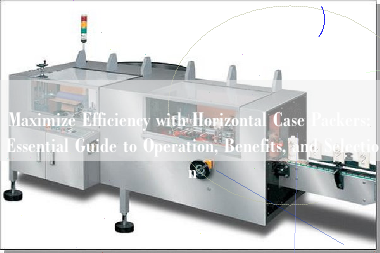
Horizontal Case Packers automate product loading into pre-formed cases positioned sideways. The core mechanism involves an indexing conveyor transporting open cases horizontally through loading zones. Products enter via an infeed conveyor—typically bottles, cans, pouches, or bags—and are precisely grouped using alignment guides or robotic arms. Pusher plates or vacuum grippers then transfer the product group laterally into the waiting case. Key structural components include:
– Infeed Conveyor System: Handles product presentation at correct orientation/speed
– Case Indexing Conveyor: Moves empty cases through loading stations
– Product Grouping Area: Forms product layers via guides, flights, or robots
– Loading Mechanism: Pushers, plungers, or robotic arms for product transfer
– Drive & Control System: Servo motors synchronized with PLC logic
This horizontal orientation accommodates fragile items like glass bottles, preventing vertical drops that cause damage.
1.2 Key Applications & Operational Advantages
Horizontal Case Packers excel in scenarios requiring gentle handling or complex product arrangements:
– Beverage Industry: Loading glass bottles into partitioned trays
– Pharmaceuticals: Handling blister packs/vials without jostling
– Food Processing: Packing pouches, snack bags, or jars in mixed configurations
– Consumer Goods: Assembling multi-SKU gift sets or promotional packs
Core Advantages:
– Reduced Product Damage: Horizontal transfer minimizes impact forces
– Configuration Flexibility: Accommodates varied layouts (e.g., 3×4, 2×6 bottle patterns)
– High-Speed Integration: Synchronizes with upstream fillers/cappers (500-1,200 cases/hour)
– Labor Savings: Replaces 3-5 manual packing stations per line
– Smaller Footprint: Requires less floor space than rotary systems
1.3 Essential Maintenance Protocols
Scheduled maintenance prevents downtime and extends equipment lifespan:
Daily Checks:
– Inspect pusher plates/end-effectors for wear or residue buildup
– Verify pneumatic pressure (5.5-7 bar) and check for air leaks
– Clean sensors (photoelectric, proximity) with alcohol wipes
– Lubricate guide rails per manufacturer specifications
Weekly/Monthly Procedures:
| Component | Action | Frequency |
|——————-|—————————————–|———–|
| Drive Chains | Tension check & lubrication | Weekly |
| Conveyor Belts | Alignment adjustment & debris removal | Weekly |
| Gearboxes | Oil level inspection | Monthly |
| Electrical Panels | Terminal tightening & dust cleaning | Monthly |
Critical Safety Precautions:
– Lockout/Tagout (LOTO) procedures before internal inspections
– Replace worn gripper pads immediately to prevent product drops
– Monitor servo motor temperatures during peak operation cycles
– Validate emergency stop function weekly
Maintaining spare pusher arms, sensors, and pneumatic valves reduces MTTR (Mean Time To Repair) by 40-60%. Yanmao Intelligent Equipment (Suzhou) recommends quarterly technical audits for optimal throughput.
2.1 Comparative Analysis of Packing Technologies
Orientation & Product Handling
- Horizontal Case Packers: Cases lie sideways during loading. Products transfer laterally via pushers or robotic arms. Ideal for delicate items like glass bottles, pharmaceuticals, or irregularly shaped goods.
- Vertical Case Packers: Cases stand upright. Products drop vertically into containers by gravity or mechanical assistance. Better suited for rigid, damage-resistant items like cans or stable plastic containers.
Throughput & Efficiency Metrics
| Parameter | Horizontal Case Packer | Vertical Case Packer |
|---|---|---|
| Max Speed | 500-1,200 cases/hour | 800-1,500 cases/hour |
| Changeover Time | 15-30 minutes | 10-20 minutes |
| Labor Requirements | 1 operator per 2 lines | 1 operator per 3 lines |
| Product Damage Rate | ≤0.2% | ≤0.5% |
Footprint & Integration
Horizontal systems typically occupy 20-30% more floor space than vertical configurations due to lateral case movement. Vertical packers integrate more easily with gravity-fed systems but require greater ceiling clearance. Both synchronize with Yanmao’s case erectors and sealers using standardized PLC interfaces.
Configuration Flexibility
Horizontal packers accommodate complex patterns like mixed SKUs, partitioned trays, or layered arrangements. Vertical systems excel at uniform grid layouts but struggle with irregular product groupings. Robotic arm options exist for both types, though horizontal variants offer finer precision for fragile items.
2.2 Selection Guidelines & Best Practices
Material-Driven Decision Framework
Choose Horizontal When:
– Handling fragile products (glass, medical devices)
– Packing deformable items (pouches, bags)
– Requiring multi-layer or mixed-SKU configurations
– Operating in low-ceiling facilities
Opt for Vertical When:
– Processing rigid cylindrical items (cans, drums)
– Prioritizing maximum throughput over configuration flexibility
– Limited floor space available
– Handling standardized product dimensions
ROI Optimization Strategies
- Throughput Analysis: Vertical packers yield 15-25% higher speeds for uniform items. Horizontal systems reduce product loss costs by up to 40% for fragile goods.
- Lifecycle Costing: Vertical models have 10-15% lower upfront costs. Horizontal variants demonstrate lower maintenance expenses over 5+ years due to reduced impact wear.
- Integration Audits: Match case conveyor heights with upstream equipment. Validate palletizer interface protocols before finalizing.
Future-Proofing Considerations
- Modular Design: Yanmao’s horizontal packers accept robotic arm upgrades without structural changes.
- Hygiene Compliance: NSF-certified models available for both types; horizontal designs simplify washdown procedures.
- Energy Profiles: Horizontal packers consume 8-12% less power during variable-speed operations.
For hybrid operations, Yanmao Intelligent Equipment offers dual-mode systems handling both orientations. Request a packaging audit to determine your optimal configuration: https://yanmaopack.com/contact/